

Crane Rental Questions, Answered by the People Running the Machine
- Reviewed by Paul Santos, Owner, MacDonald Crane
- Published September 2026 · Updated September 2026

Request a Lift Quote
Before You Call
Is this even a crane job?
Not always. If the load can be moved safely with a hoist or telehandler because there is clear access, a crane may not be the right choice. The first step is to look at the load, the obstacles and where it needs to land.
What makes a lift harder than it looks?
Access is often the deciding factor. A lighter load can require more planning than a heavier one if it has to travel farther from the crane or over obstacles such as buildings, parapets, fences or parked vehicles.
What if I do not know the load weight yet?
You can still start the conversation. Tell us what the equipment or material is and send a photo, model number or available documentation. The lift should not be planned from an unverified weight.
What happens if the site is not ready for a crane?
The lift may need to be delayed or the setup changed. Ground conditions, access, overhead clearance and the planned landing area all need to support the lift before the crane is positioned.
What It Costs and How the Billing Works
Why do two crane quotes for the same job come back so far apart?
Usually because the two companies priced different machines, different hours, or different scope. One may have included rigging and the other left it out. One may bill from the yard and the other from your gate.
Ask both quotes the same four questions. Which machine, how many hours, what the minimum is, and when the clock starts. Quotes stop looking mysterious once those line up. A cheaper hourly rate on a bigger machine with a longer minimum is not cheaper, and an hourly rate quoted without a machine attached is not a quote at all.
What does port to port mean on a crane invoice?
It means the clock runs from the moment the crane leaves our yard in Easton to the moment it is back. Not from when it reaches your gate.
The operator logs shop out, on site, job done, and shop back. That span is what appears on the invoice. A job two hours out carries a different bill from the same job twenty minutes away. That is a scheduling decision as much as a cost one, and it is worth working out before you pick a date.
What is not covered by the hourly rate?
Street permits and police details are not ours to pull. Those sit outside anything we bill. Every job carries a fuel surcharge, and anything unusual in the rigging gets discussed before it is quoted.
We do not run hidden fees, and the way we prove it is by publishing the rates rather than describing them. What you are quoted on the phone is what lands on the invoice.
Does a bigger crane always cost more?
Per hour, yes, and the minimum is longer too. Whether the job costs more is a different question.
A larger machine sometimes finishes in fewer hours because it can set up somewhere more convenient and make the pick in one go. A smaller crane that has to be repositioned twice can end up the more expensive answer. We size the machine to the pick rather than to the quote.
Can I get a fixed price instead of an hourly rate?
Operated crane work is billed by the hour against a minimum, so a flat price is not how the trade prices it. What we can do is put a realistic band of hours against your job before you book.
Send the three numbers and the address and you will get a machine, an expected run of hours, and the minimum it books at. That is close enough to a fixed number to build a bid around. Where the hours genuinely cannot be predicted, usually because access is unresolved, we will say so rather than quote a figure that moves later.
Capacity, Reach and Which Crane the Job Takes
Why does a 50-ton crane not lift 50 tons?
Because the rating changes with the distance between the crane and the load. A crane's rated tonnage does not represent the same lifting capacity at every working distance.
Push the same load farther from the crane, over a parapet or across a roof, and the available capacity decreases. That is why the tonnage in the machine's name tells you very little about your own pick.
What is a load chart, and why will nobody show me one?
A load chart is the manufacturer's table showing what a crane can lift at different boom lengths and working distances. It is not one number, it is a grid, and it has to be read in the context of the specific setup.
We do not publish ours because a chart taken out of context can give you a number that does not apply to your job. Boom configuration, outrigger position and the lifting arrangement all affect capacity. Tell us the weight and working distance, and we can determine what the machine can handle.
What does radius mean, and why does everyone keep asking for it?
Radius is the horizontal distance from the centre of the crane to the load, measured on the ground. Not the boom length, and not the height.
It is the variable that decides capacity more than any other, and it is the one callers almost never have ready. Pace it out from where a crane could sit to where the load has to land. That single measurement changes the answer more than anything else you can send us.
Is an estimated weight good enough, or do you need the real figure?
An estimate is fine to start the conversation. It is not fine to plan the lift on. Before the date we want the figure off the nameplate or the shipping paperwork.
Guessed weights run light far more often than heavy, because people quote the dry or open weight of something that arrives full and enclosed. A generator is the classic example. The same set can more than double once the enclosure and fuel tank are counted.
What happens if the weight is wrong on the day?
The operator reassesses the pick against the crane's operating limits. If the load cannot be safely lifted under the actual conditions, the lift does not proceed.
An incorrect weight can change whether the planned setup is suitable. Whenever possible, provide verified load information before the crane arrives so the machine can be selected around the load that will actually be lifted.
The machines: 30-ton boom truck crane 50-ton boom truck crane
Site Access, Ground and Setting Up
Can a crane set up on grass, or does it need pavement?
Grass works in plenty of cases, with pads under the outriggers to spread the load. What matters is what the ground can carry, not what it is covered in.
Saturated ground is the problem, not soft ground in principle. New England spring is the worst of it, because bearing capacity drops sharply once the frost comes out. Tell us the time of year and what the setup area is made of.
Will the outriggers damage my parking lot or driveway?
They can, and pads are what stop it. The outrigger footprint concentrates a great deal of weight into a small area, and August asphalt is soft enough to take an impression.
We bring pads and cribbing on every job for exactly this reason. If the surface is new, decorative, or something you would rather not gamble on, say so when you book and we will plan the setup around it.
What is underneath the setup area that you need to know about?
Septic tanks, leach fields, buried oil tanks, utility vaults, basements and underground parking. Anything with a void under it.
This is the question that catches people out, and it matters more in older New England housing stock than almost anywhere. A surface that looks solid can sit over something that will not take an outrigger. If you do not know what is under it, tell us that, because not knowing is itself useful information.
Does the ground have to be level?
Close to it. Cranes level themselves on their outriggers, and that adjustment has limits. A mild slope is workable and a steep one is not.
A steep driveway is the common residential version of this. The crane ends up on the flat street instead, which changes the radius and sometimes the machine. Send a photograph taken along the ground rather than down at it, because slope never shows up in a photograph taken from above.
How much of my site do you need for the day?
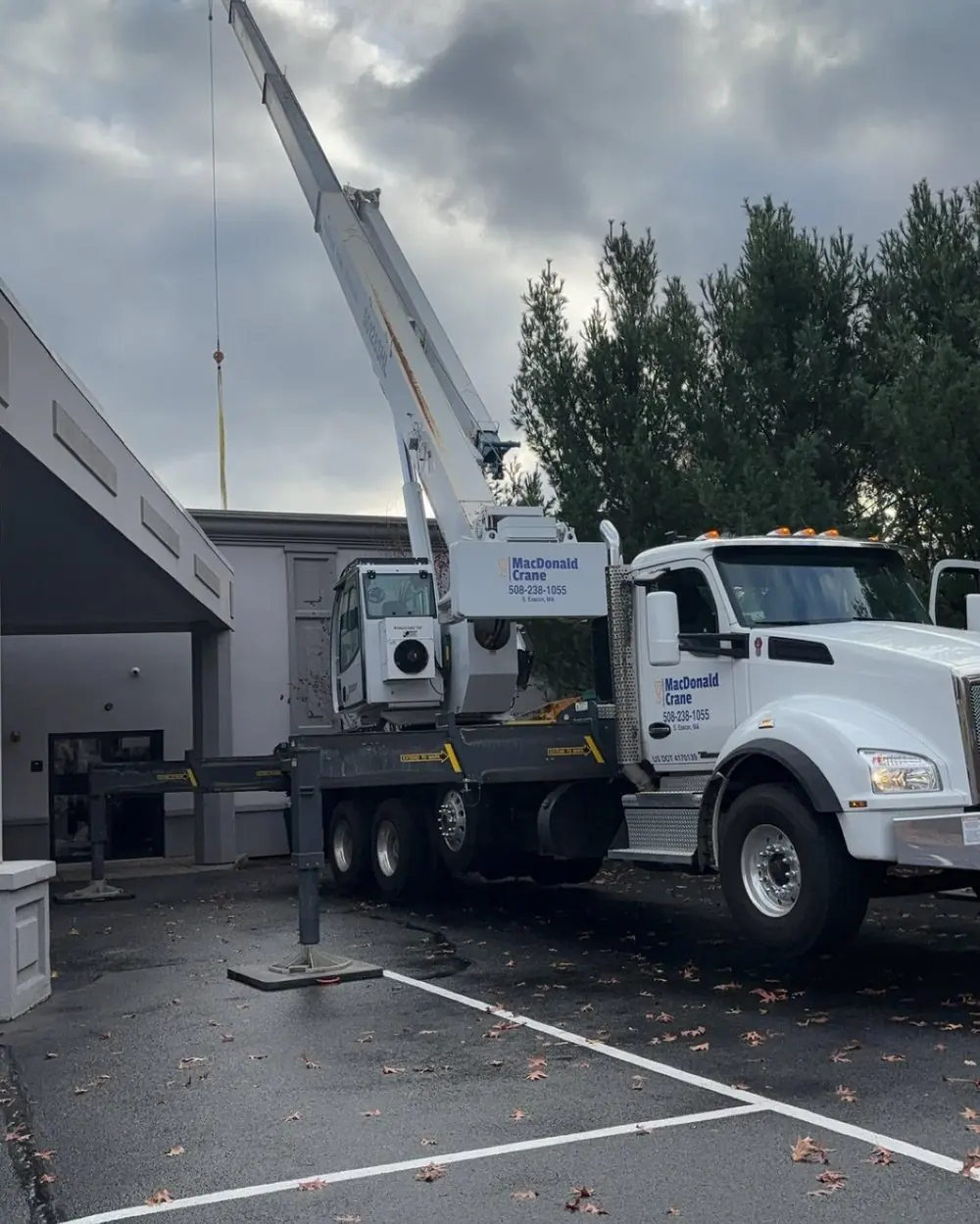
Enough for the crane to extend its outriggers fully, plus the room the boom swings through, plus a clear path in and out. The outrigger spread is wider than the machine itself.
On a commercial lot that usually means a corner and a couple of rows coned off. We agree which part before the date rather than on lift day. On a retail site the property manager is often the harder permission to get.
Plan it first: 3D lift planning, on request
Permits, Insurance and Who Is Responsible
Who is responsible if something is damaged during the lift?
It depends on what was damaged and why, and the contract between us is what governs it. Crane companies carry their own liability cover, and riggers liability is the part that answers for a load damaged in the lift.
Read the terms before you book rather than after something happens. Ask any crane company what they carry, ask for the certificate, and check whether your own contract with the building owner pushes obligations onto you that you need to pass along.
Can you be named as additional insured on my policy?
Tell us what your contract requires and we will tell you what we can do. Requirements vary a lot between a private owner and a large general contractor, and the wording matters.
Send us the insurance clause from your contract when you book rather than the week you start. It is the single most common reason a booked crane cannot mobilise on the day, and it is entirely avoidable with notice.
Do I need my own insurance to hire a crane?
Usually yes, and your own general liability policy is normally what covers your side of the work. We carry ours and you carry yours.
What we will not do is advise you on your own coverage. What we can do is get you our certificate of insurance within one business day of you asking, so whoever is checking paperwork on your side has it early.
What has to happen before a crane can set up on a public street?
The town has to approve it. That normally means a street occupancy permit, and depending on the road it can also mean traffic control or a police detail. We do not pull permits and we do not book police details.
Rules differ town to town across Massachusetts, and Boston is materially stricter than a suburban town. Verified September 2026. Start with whoever runs your job and the town's own office, and start early, because this is the approval most likely to move a date.
When does a lift need a police detail?
When the crane or the work zone takes a public way, in most Massachusetts municipalities. The town decides, not us.
We do not pull permits and we do not book police details, and that sits with whoever schedules the job. We are happy to tell you what the crane needs in terms of space and duration so that whoever applies has the right information to give.
What we carry: Safety and certifications
Operators, Licensing and Who Makes the Call
Does Massachusetts require its own crane licence?
Yes. Massachusetts has state hoisting machinery licensing requirements in addition to national operator certification. The two are separate requirements, and one does not replace the other.
State licensing and national certification serve different purposes. Contractors should make sure the operator assigned to the work meets the requirements that apply to the specific lift and jobsite.
What does the operator do besides run the crane?
Reads the chart, decides where the machine sets up, checks the ground, sizes the rigging, and walks the pick through with your people before anything leaves the ground. The lifting is the last part.
This is most of the argument for hiring a crane with an operator rather than a machine on its own. The person who knows what the crane will and will not do is standing on your site while the decisions get made.
Who gives the signals, your operator or my crew?
Either, as long as it is agreed before the pick and one person owns it. Several people signaling at once is what causes a dropped instruction.
Standard crane hand signals are an established set, and the Massachusetts licence tests on them. Nominate one person on your side, introduce them to the operator at the walk through, and keep everybody else off the radio. If the load goes out of the operator's sight at any point, that signaler is the only thing keeping the pick under control.
Can the operator refuse to make a lift?
Yes, and it is the operator's call rather than a conversation. If the ground, the weather, the weight or the rigging does not add up, the pick does not happen.
Nobody enjoys that outcome and it is rare. Most of these get caught before the date. The person running the machine has the final say, and schedule pressure does not change it.
How we work: Operated crane rental
Working Out the Load
How do I find what my load weighs with no data plate?
Work it out from the material, dimensions and available manufacturer information. For steel, the section designation can provide the weight per unit of length.
For concrete, dimensions and material density can help estimate the weight. For manufactured equipment, the manufacturer's specifications are usually the best source. If the weight is uncertain, send us whatever information you have before the lift is scheduled.
Why does where the load balances matter as much as what it weighs?
Because a load that is heavier at one end tips when it leaves the ground unless it is rigged for it. Weight tells us whether the crane can lift it. Balance tells us whether it will hang level.
A cabinet full of equipment at one end, a beam with a plate welded off centre, a tank with liquid still in it. Tell us if the weight is not evenly spread, and tell us where the heavy end is.
What are tag lines, and will I need people on them?
Tag lines are ropes attached to the load so someone on the ground can stop it swinging or turning. On most picks somebody is on one.
They keep the load under control while it travels, and they matter more on light loads with a large surface area than on dense ones. A sheet of plywood and a pallet of block behave nothing alike on the end of a line. Plan for a person or two of yours to be free for it rather than pulling them off other work at the last minute.
Can you lift something that was never designed to be lifted?
Often, and it is a rigging question rather than a crane question. Plenty of loads have no lifting eyes and get slung instead.
What we need to know is where it can take the pressure and where it cannot. Glass, thin sheet, old timber and anything with a fragile skin all change the answer. Send photographs of all four sides and tell us what it is made of.
The hardware: Rigging services
Weather, Delays and Calling It Off
How much wind is too much wind to lift?
No single number covers it, and anybody who hands you one is guessing. The limit comes from the manufacturer's chart for that machine and the surface area of the load.
A dense, compact load handles wind far better than something light and broad, which behaves like a sail. A bundle of steel and a run of roofing panels carry different limits on one afternoon with one crane. The operator makes the call on site.
What happens if it rains on the day?
Rain on its own rarely stops a pick. Visibility, wind and what the ground turns into are what stop it.
A site that was firm on Monday can be unusable on Thursday after two days of rain, and that is the more common reason a wet date moves. If the forecast looks poor we would rather talk the day before than have everybody show up to a site that cannot take a crane.
Do you lift through the winter in New England?
Yes. Cold on its own is not the problem, and frozen ground carries an outrigger better than soft ground does.
The seasonal issue is the thaw rather than the freeze. When frost comes out of the ground in spring, bearing capacity drops sharply and setup areas that held all winter stop holding. Snow clearance around the setup area is on you.
Who decides to call a lift off?
The operator, on site, with the final word. Before the day it is a conversation between us and whoever is running the job.
Weather calls get made as late as they sensibly can be, because forecasts three days out move. If the date has to shift we will tell you as soon as we know rather than leaving you to guess.
Planning ahead: Book two to three days out
Choosing a Crane Company
What should I ask any crane company before I book?
Five things. Which machine are you sending, is the operator included, what is the minimum, when does the clock start, and can I see your certificate of insurance.
Those five separate a company that has thought about your job from one reading off a price list. A company that cannot tell you which machine it is sending has not worked out whether the pick is possible.
What does operated rental mean?
It means the crane arrives with a qualified operator who works for the crane company, and that operator runs the machine for the duration. You are hiring a service rather than a piece of equipment.
The alternative is a bare rental, where you take the machine and supply your own certified operator. We do not do bare rentals. Every crane we send goes out with one of our own people on it.
How do I check a crane company is genuinely insured?
Ask for the certificate of insurance and read it rather than filing it. Check that the policy is current, check the limits against what your contract requires, and check that riggers liability appears if a dropped load is a concern.
A company that is slow to produce a certificate is telling you something. Ours goes out within one business day of being asked.
What are the signs a company is out of its depth on your job?
They quote without asking what the load weighs. They cannot say which machine is coming. They agree to a radius without asking what is in the way.
The reverse is a good sign. A company that asks awkward questions before quoting, and occasionally tells you the job is not theirs, is one that has read the chart. We turn down work that wants a bigger machine than we run, and we would rather say so early.
Who we are: About MacDonald Crane
Did Not Find Your Answer?
Send the question and we will answer it. If it is one other people are asking, it goes on this page.
Your question
First name
Email
Or call (508) 238-1055 if you would rather talk it through.
Send It Over
How This Page Was Built
The questions here were assembled in September 2026. The questions were selected from MacDonald Crane's customer questions, Search Console queries, and supporting search research. Each question was reviewed against the site's existing FAQ content before inclusion. Thirty-nine made the page out of a longer list.
Every question was screened against the eighty questions already answered elsewhere on this site. Nothing here repeats an answer you will find on a service page, and where a question belonged to a service page it was left there.
Verified September 2026: the Massachusetts hoisting regulation at 230 CMR 6.00, the certificate of insurance turnaround, the booking lead time, and the published boom lengths and rating conditions for the Manitex 30100C and the Manitex 50128S.
Next review March 2027, owned by MacDonald Crane with RS Gonzales. Questions sent through the form above are read as they arrive and the page is updated between reviews when one comes up more than once.
Reviewed by Paul Santos, Owner, MacDonald Crane
111 Eastman St, Easton, MA 02375 · (508) 238-1055
Published 9 September 2026 · Updated 9 September 2026
 Get a Lift Quote