


In this article
- When Does OSHA Allow Workers to Be Lifted in a Crane Man Basket?
- OSHA’s Rules for Contractors Under 29 CFR 1926.1431
- What Inspections and Tests Are Required Before a Personnel Lift?
- What Safe Work Practices Must Contractors Follow During the Lift?
- How Do Wind, Weather, and Power Lines Affect Personnel Lifts?
- Who Is Responsible for Planning and Approving the Lift?
- Why Choose MacDonald Crane for Personnel Lift Planning in South Easton?
- Frequently Asked Questions
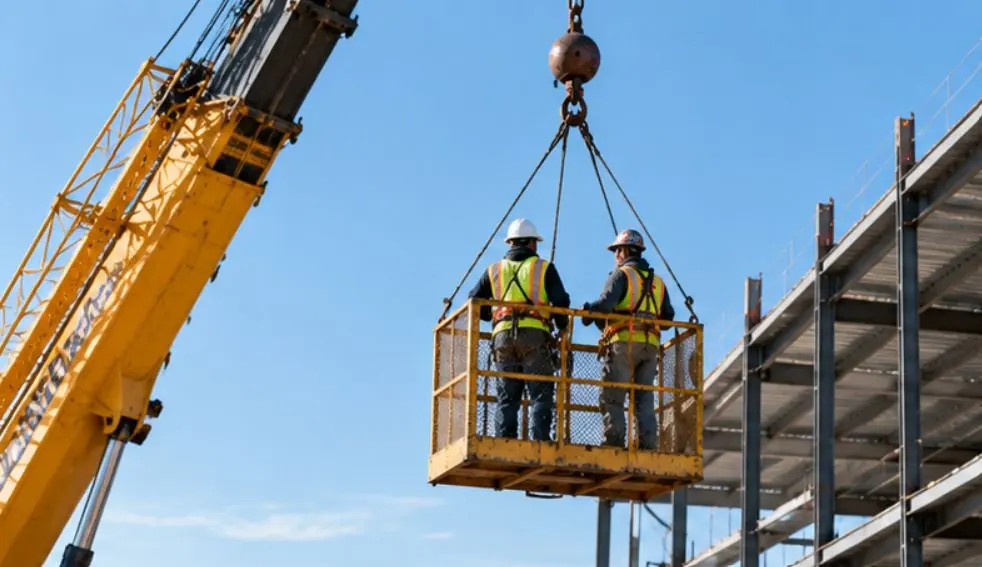
Your HVAC crew needs access to rooftop equipment, a general contractor needs workers near an elevated steel connection, or a crew must reach a work area where scaffolding will not fit. A crane man basket might seem like the quickest solution, but lifting workers requires more than attaching a personnel platform to a crane. OSHA limits when this method can be used and sets specific requirements for equipment, inspections, testing, fall protection, and operator communication.
Under OSHA’s rules for hoisting personnel, 29 CFR 1926.1431, employers must demonstrate that conventional access methods would create a greater hazard or are not possible because of the project’s structural design or worksite conditions. When a crane-suspended personnel platform is permitted, contractors must follow the applicable requirements before anyone boards. Understanding these rules helps HVAC contractors, general contractors, and site supervisors plan personnel lifts without treating safety checks as optional steps.
When Does OSHA Allow Workers to Be Lifted in a Crane Man Basket?
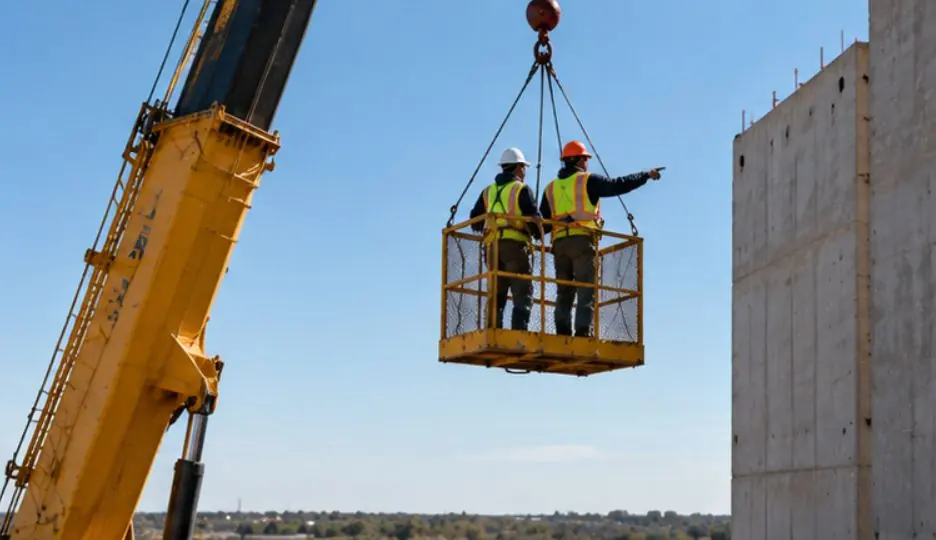
OSHA generally permits crane-suspended personnel platforms only when conventional access methods, such as scaffolds, ladders, aerial lifts, or personnel hoists, would be more hazardous or are not feasible. A crane basket cannot be selected simply because it is faster, cheaper, or more convenient than another access method.
For example, an HVAC contractor installing rooftop ductwork may need to reach an area blocked by building geometry or restricted ground access. For steel erection covered by OSHA Subpart R, the conventional-access restriction in 29 CFR 1926.1431(a) does not apply, although the remaining personnel-platform requirements still do. In other cases, the employer must evaluate the actual conditions and document why conventional access is more hazardous or not possible.
Before scheduling the lift, contractors should:
- Evaluate whether scaffolding, an aerial lift, or another access method is feasible.
- Document the site conditions that justify using a personnel platform.
- Identify the work location, lifting route, and intended platform position.
- Confirm that the crane, platform, and rigging are suitable for personnel lifting.
Certain specialized operations have separate provisions or exceptions under OSHA’s standard. Contractors should review the rules that apply to their specific work rather than assuming every personnel lift follows an identical process.
OSHA’s Rules for Contractors Under 29 CFR 1926.1431
Once personnel lifting is justified, contractors must meet the applicable requirements for crane capacity, equipment setup, platform design, testing, and safe work practices. These requirements work together; satisfying one does not make up for a missing inspection or an unsuitable platform.
The 50% Crane Capacity Limit
For a suspended personnel platform, the total load, including the loaded platform, hook, load line, and rigging, must not exceed 50% of the crane’s rated capacity for the actual radius and equipment configuration, except during proof testing. For boom-attached platforms, the standard specifies the corresponding limit for the loaded platform.
This limit must be checked against the crane’s load chart at the planned working radius. Capacity can decrease as the boom extends or the radius increases, so a lift that appears acceptable near the crane may exceed the permitted limit farther away.
Contractors should account for:
- The platform’s own weight and rated capacity.
- The number of workers and their combined weight.
- Tools and materials needed to perform the task.
- The hook, load line, and rigging where applicable.
- The actual boom configuration and working radius.
Do not estimate capacity using the crane’s maximum advertised lifting capacity alone. The operator and lift-planning team must verify the numbers for the specific setup.
Crane Setup and Required Safety Devices
OSHA requires the crane or other applicable equipment to be level within 1% of grade and positioned on footing that a qualified person determines is sufficiently firm and stable. Outriggers or stabilizers must all be extended and locked to the same amount of extension, in accordance with the manufacturer’s procedures and load charts.
The required safety devices must also be functional before personnel hoisting begins. Depending on the equipment, these include boom angle indicators, boom-hoist limiting devices, and other devices specified by the standard. Personnel hoisting must stop if a required device becomes inoperative and cannot resume until it is functioning properly.
For HVAC and general contractors, this means confirming the ground conditions, equipment configuration, and operating limitations before the scheduled lift. A suitable crane is not enough if the setup cannot safely support the planned operation.
Personnel Platform Design and Fall Protection
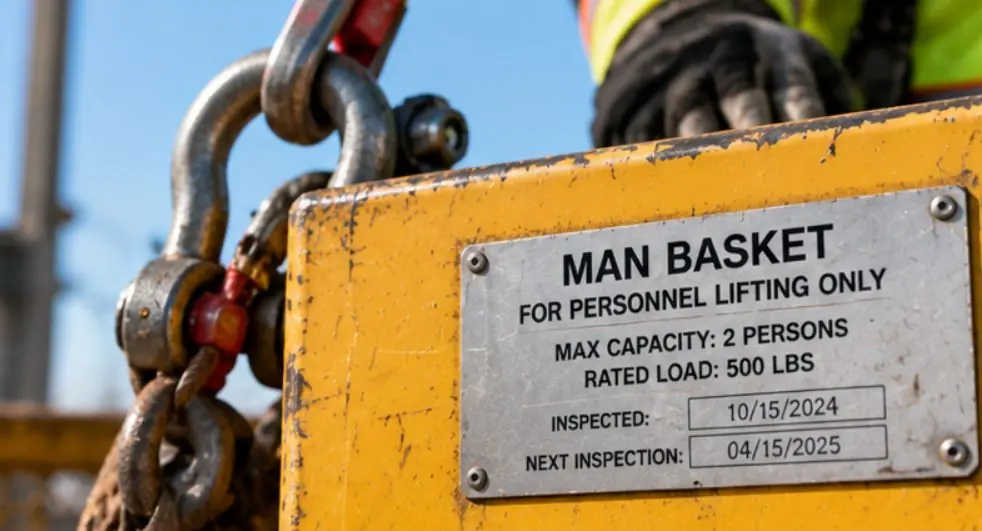
The personnel platform and its attachment or suspension system must be designed by a qualified person familiar with structural design. Under OSHA’s standard, the platform itself, excluding the guardrail system and personal fall-arrest anchorages, must support its own weight and at least five times the maximum intended load without failure.
The platform must also meet specific construction and safety requirements, including:
- Guardrails and appropriate enclosure to protect occupants.
- A grab rail around the interior perimeter, except at access gates or doors.
- An access gate that does not swing outward, subject to OSHA’s narrow exception.
- A permanent marking showing the platform’s weight and rated capacity.
- Overhead protection when workers face falling-object hazards.
- Suitable anchorages for personal fall-arrest systems.
Except when working over water, occupants must be provided with and use a personal fall-arrest system attached to a structural member within the personnel platform. The system must meet OSHA’s applicable fall-protection requirements. Workers should never improvise an attachment point or assume that any basket is suitable for lifting people.
What Inspections and Tests Are Required Before a Personnel Lift?
OSHA requires a defined inspection and testing process before workers are hoisted. Contractors should build this time into the project schedule instead of trying to complete checks after the crew is ready to board.
Trial Lift and Equipment Inspection
An unoccupied trial lift must be performed with the platform loaded at least to the anticipated lift weight. The platform must travel from the boarding location to each planned work position using the intended lifting route. The trial lift is required immediately before each shift in which personnel will be hoisted and must be repeated in specified circumstances, including a new setup location or a changed route that introduces new safety factors.
After the trial lift, a competent person must inspect the equipment, ground or base support, and platform for defects or adverse effects. Immediately before the actual lift, the platform must also be raised a few inches with workers and their tools aboard so the competent person can check that it is secure and properly balanced.
Proof Testing at 125% of Rated Platform Capacity
Before employees are lifted at a jobsite, and after repairs or modifications, OSHA requires the platform and rigging to be proof-tested to 125% of the platform’s rated capacity. This test may be performed at the same time as the trial lift.
During the proof test, the platform must be lowered using controlled load lowering, braked, and held suspended for at least five minutes with the test load distributed evenly. A competent person must inspect the platform and rigging afterward. Personnel lifting cannot begin until that person determines the test was passed.
Keep the distinction clear: the 50% limit governs the crane’s rated capacity during the personnel lift, while the 125% figure applies to proof-testing the platform and rigging. They are different requirements and should not be confused during lift planning.
What Safe Work Practices Must Contractors Follow During the Lift?
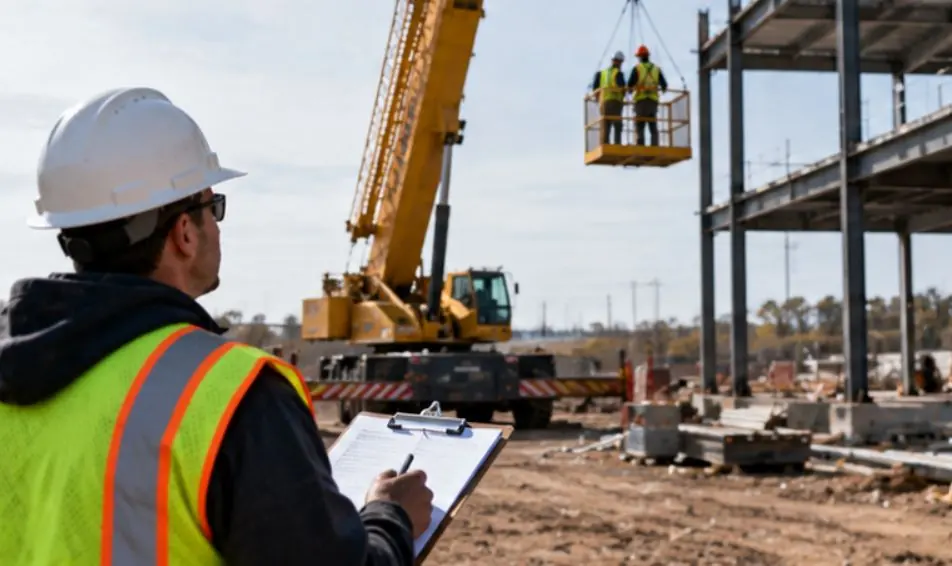
Passing inspections and tests does not remove the need for safe operating procedures. OSHA requires personnel platforms to be hoisted slowly and cautiously, without sudden crane or platform movements. Workers must keep their bodies inside the platform while it is being raised, lowered, or moved horizontally, and they must not stand on guardrails or use objects to gain extra height.
Contractors and crews should also confirm the following before and during the lift:
- Communication: Occupants must remain in direct communication with the signal person, where used, or the operator.
- Fall protection: Workers must use the required personal fall-arrest system, except where the standard’s over-water provisions apply.
- Platform entry and exit: A suspended platform must be secured to the structure before workers enter or exit, unless securing it would create a greater hazard.
- Other load lines: Other equipment load lines generally cannot be used for lifts while personnel are being hoisted, subject to the standard’s specified exception.
- Operator presence: The operator must remain at the equipment controls, on site and in view of the equipment, while the platform is occupied, subject to the applicable provisions for platforms with controls.
The pre-lift meeting must include the operator, signal person if one is used, workers being hoisted, and the person responsible for the task. Hold the meeting before the trial lift at each new work location and repeat it when newly assigned workers join the operation.
How Do Wind, Weather, and Power Lines Affect Personnel Lifts?
Environmental conditions can make an otherwise compliant lift unsafe. OSHA requires a qualified person to determine whether dangerous weather or other existing or impending hazards make personnel lifting unsafe. If conditions are unsafe, the lift must not begin or must be terminated if already underway.
For wind, OSHA specifies that when sustained wind or gusts exceed 20 mph at the personnel platform, a qualified person must determine whether lifting workers is unsafe under those conditions. The 20 mph figure is not an automatic universal cancellation point; the required safety determination must consider the actual conditions.
Contractors should also consider:
- Gusts that could cause the platform to swing or become difficult to control.
- Lightning, ice, snow, or reduced visibility.
- Ground conditions that could affect crane stability.
- Nearby power lines and the required clearances.
- Whether the operator and platform occupants can maintain reliable communication.
OSHA’s personnel-hoisting standard prohibits hoisting workers within 20 feet of power lines up to 350 kV and within 50 feet of lines above 350 kV, subject to the standard’s stated exception for work covered by Subpart V. Contractors must verify the applicable electrical-safety requirements before finalizing the lift plan.
Who Is Responsible for Planning and Approving the Lift?
Personnel lifting requires coordination among the employer, crane operator, competent person, signal person where used, and the workers who will occupy the platform. Each has a role in making sure the lift is planned and conducted safely.
| Role | Primary responsibility |
|---|---|
| Employer responsible for the personnel-hoisting operation | Evaluate whether conventional access is more hazardous or infeasible and coordinate the worksite plan. |
| Crane operator | Operate within the crane’s rated capacity and follow the lift plan and required procedures. |
| Competent person | Perform or oversee the inspections and determine whether required checks have been satisfied. |
| Qualified person | Complete duties requiring the relevant expertise, including platform design or specified safety determinations. |
| Signal person and platform occupants | Maintain communication, follow signals, use required fall protection, and stop the operation when necessary. |
Contractors should identify who is responsible for each step before the crew arrives. Keep applicable project documentation and any records required by the employer, site procedures, or other regulations organized. Clear responsibilities and documentation make it easier to verify that the required process was followed.
Why Choose MacDonald Crane for Personnel Lift Planning in South Easton?
When an HVAC installation, rooftop project, or structural task requires elevated access, the first question is whether a crane-suspended personnel platform is permitted under the site conditions. MacDonald Crane serves contractors in South Easton, Massachusetts, with crane rental services for construction and equipment-handling needs. Discussing access constraints, the work location, and the planned lift in advance helps establish what equipment and planning the job may require.
If your project involves both personnel access planning and separate material-handling lifts, coordinate those needs early so the schedule, crane configuration, and site requirements can be evaluated. Call (508) 238-1055 or request an estimate from MacDonald Crane to discuss your project and determine the next planning steps.
Frequently Asked Questions
Can a contractor use a crane man basket simply because it is faster?
No. OSHA generally permits personnel hoisting only when conventional access methods would be more hazardous or are not possible because of the structure or worksite conditions. Convenience, speed, or cost savings alone do not meet this requirement.
Does the crane’s rated capacity have to be reduced to 50%?
For a suspended personnel platform, the total load, including the platform, hook, load line, and rigging, cannot exceed 50% of the crane’s rated capacity for the actual radius and configuration, except during proof testing. The standard specifies a corresponding rule for boom-attached platforms.
How much proof testing is required before lifting workers?
OSHA requires the personnel platform and rigging to be proof-tested to 125% of the platform’s rated capacity at each jobsite before employees are hoisted and after repairs or modifications. The platform must be held suspended for at least five minutes during the test.
Can workers be lifted when wind exceeds 20 mph?
When sustained wind or gusts exceed 20 mph at the platform, a qualified person must determine whether conditions make the lift unsafe. If the lift is unsafe, it must not begin or must be stopped.
Can the same crane lift materials and workers at the same time?
Generally, no. OSHA restricts the use of other equipment load lines while personnel are being hoisted, subject to specific exceptions. Personnel platforms are for employees and the tools or materials necessary for their work, not for routine material handling when workers are not being lifted.
 Get a Lift Quote