


In this article
- What Does OSHA Require Under the Outriggers?
- What Must the General Contractor Do?
- Who Owns the Ground on Common Crane Jobs?
- How Much Load Does an Outrigger Put on the Ground?
- Do the Crane Company’s Mats Make It Their Problem?
- Who Handles What When You Book a Crane?
- What Hides Under Commercial Lots and Job Sites?
- What Should You Send With Your Crane Request?
- Why Choose MacDonald Crane for Contractor Lifts in Massachusetts?
- Frequently Asked Questions
If you are the general contractor serving as the controlling entity on the project, OSHA places the ground-preparation responsibility on you. Under 29 CFR 1926.1402, the controlling entity is the prime contractor, general contractor, construction manager or other legal entity with overall responsibility for the project.
HVAC contractors can also take on that responsibility. If there is no controlling entity, the duty falls to the employer that has authority at the site to make or arrange the required ground preparations. On some direct HVAC projects, that may be the mechanical contractor.
What Does OSHA Require Under the Outriggers?
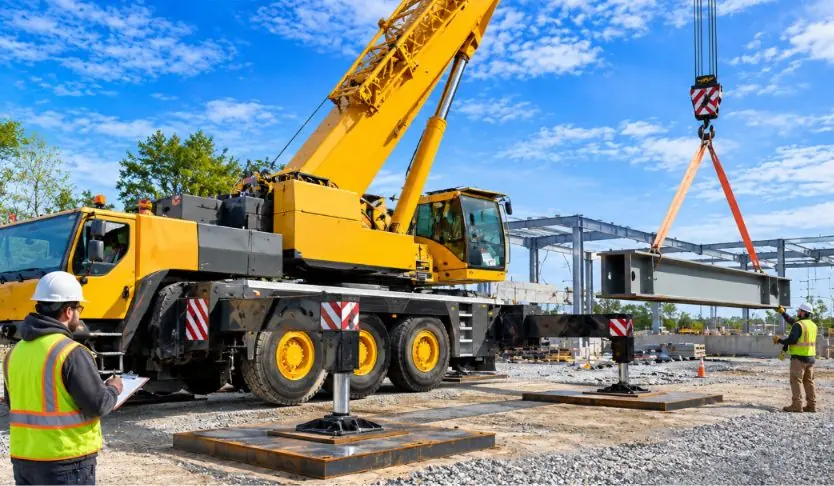
OSHA defines ground conditions as the ability of the ground to support the crane, including slope, compaction and firmness. Supporting materials are the blocking, mats and cribbing placed under outriggers to spread the load. Both have to work together for the crane to set up legally.
The core rule is short. A crane may not be set up or used unless the ground is “firm, drained, and graded to a sufficient extent” that, with supporting materials if needed, it meets the crane manufacturer’s specifications for support and for how level the crane must sit. That responsibility does not end after initial setup; changing ground conditions must be addressed while the crane remains in use.
For a contractor, that means the setup spot is part of your job scope, not the crane company’s alone. Ground that carries your delivery trucks may not carry a loaded outrigger lifting a 5-ton rooftop unit at a long radius over a parking lot or a building edge.
What Must the General Contractor Do?
OSHA’s definitions describe the controlling entity as a prime contractor, general contractor, construction manager or other legal entity with overall responsibility for the project. On most new construction and tenant work, that is the general contractor, even when a subcontractor booked the crane.
The controlling entity has two duties. It must make sure the ground preparation the crane needs is provided, and it must tell the crane user and operator about voids, tanks or utilities beneath the setup area when those appear in site drawings, as-built plans or soil reports it holds.
You can hire out the grading or stone work, but you remain the party responsible for seeing that it gets done. Before your HVAC, steel or framing sub books a crane, decide together where it will set up and who is preparing that spot.
Who Owns the Ground on Common Crane Jobs?
The answer changes with the kind of job and who is running it. These five situations cover most crane work booked by general and HVAC contractors in Massachusetts, from new construction to a one-day rooftop unit swap with no general contractor anywhere on the site.
New Construction With a General Contractor
The general contractor is the controlling entity. It prepares the setup area and shares any known buried hazards, even when a framing, steel or mechanical subcontractor books the crane. Subs should confirm the setup spot with the GC before the crane date, not on arrival.
An HVAC Sub on a GC-Run Project
When the mechanical contractor books the crane on a GC-run job, the GC still owns the ground duty. Send the GC your setup spot and crane size early, so the area is cleared, graded and checked against site drawings before the rooftop units or condensers arrive.
An HVAC Changeout With No General Contractor
On a rooftop unit replacement hired directly by a building owner, there may be no controlling entity. OSHA then places the ground-preparation duty on the employer with authority at the site to make or arrange that preparation. On some direct HVAC projects, that may be the HVAC contractor.
Work for a Property Manager
Retail plazas, office parks and apartment complexes often hire contractors directly. Ask the property manager for site plans showing storm drains, underground tanks and utilities under the parking lot, because you will need that information to choose a safe setup spot for the crane.
The Crane Company’s Part on Every Job
A competent person must inspect ground conditions as part of the crane’s each-shift inspection. If the operator or A/D director identifies inadequate ground, that person’s employer must discuss the needed preparation with the controlling entity before lifting, whether that means more mats, a new spot or ground work.
The takeaway is that the controlling entity is responsible for providing the necessary ground preparation. If there is no controlling entity, that responsibility falls to the employer with authority to arrange the preparation. Settle who preps the setup spot when you book the crane, not on lift day.
How Much Load Does an Outrigger Put on the Ground?
More than most contractors expect. During a lift, much of the crane’s weight and the load can shift onto one or two outriggers, each pressing on a small footprint. That is why pavement that handles delivery trucks can crack or settle under a loaded outrigger.
Pads and mats spread that load. Outrigger pad maker DICA gives a sizing example: an outrigger reaction of 140,000 pounds on ground rated at 2,500 pounds per square foot needs about 56 square feet of mat. Real numbers depend on the crane, the lift radius and the soil.
Rooftop unit picks often push those numbers up, because the crane has to reach over a building edge to set the unit. A crane lift plan works out the radius, outrigger loads and setup spot before the crane leaves the yard.
Do the Crane Company’s Mats Make It Their Problem?
Once the crane company brings its own mats and its operator picks the exact outrigger positions, it is tempting to assume the ground has become the crane company’s responsibility. After all, it chose the spot, leveled the crane and decided how much cribbing to use.
Here is the trap. Mats spread a load, but they do not fix soft, saturated or undermined ground, and they do not change who OSHA holds responsible. The controlling entity must provide the required ground preparation and share known hazards covered by OSHA’s disclosure rule. If there is no controlling entity, the employer with authority at the site must make or arrange the required ground preparation.
The better approach is shared planning before the crane date. You prepare the setup spot and flag anything buried below, and the crane company sizes mats to the crane and the lift. Both sides talking early is what keeps a rooftop pick from turning into a ground failure.
Who Handles What When You Book a Crane?
Most crane jobs follow the same division of work, whatever the contract wording. The table below shows who usually handles each ground-related task on a general contractor or HVAC contractor job, and where the duty comes from, so you can check your job before booking:
| Task | GC-run job | Direct HVAC changeout | Basis |
|---|---|---|---|
| Prepare and grade the setup area | General contractor / controlling entity | Employer with authority to arrange ground preparation | OSHA 1926.1402(c)(1), (d) |
| Share known hazards below | Controlling entity | Request available site information from the owner or property manager and communicate known hazards | OSHA 1926.1402(c)(2) for the controlling entity; planning practice on a direct job |
| Choose and place outrigger mats | Crane company | Crane company | Manufacturer specifications |
| Inspect ground conditions | Competent person | Competent person | OSHA 1926.1412(d)(1)(x) |
Contracts can add tasks, but they cannot erase the OSHA duties. If your subcontract or service agreement says nothing about ground preparation, settle it before the crane date. A short email naming who preps the ground and who supplies mats prevents most disputes.
What Hides Under Commercial Lots and Job Sites?
Many ground problems are invisible from the surface, and the setup spots contractors choose most often, parking lots and driveways, hide the most. These are the hazards that most often sit under a planned outrigger position on commercial and residential jobs in Massachusetts:
- Storm drains and catch basins: Common in parking lots beside buildings.
- Underground tanks and utilities: Fuel tanks, gas lines and electric conduits.
- Fresh backfill: Soil near new foundations or utility trenches stays loose.
- Septic systems: Tanks and leach fields on residential and rural lots.
- Spring thaw: Ground that was solid in winter softens as frost leaves.
If ground preparation involves excavation as defined by Massachusetts law, including grading or moving earth, contact Dig Safe at least 72 business hours before the work, excluding weekends and legal holidays. Mark known buried features on a site sketch and send it with your crane request, so the operator can plan around them.
What Should You Send With Your Crane Request?
Ground planning is easiest when it starts at the quote. The crane company needs to know where the crane will sit and what lies underneath before it sizes the crane and the mats. Sending the right details up front saves a site visit and a delay.
Include these items every time you request a crane, for rooftop units, steel, trusses or any other pick. Each one answers a question the operator would otherwise have to ask on the day, while your crew and the crane both stand idle:
- Setup spot: Marked on a site plan or aerial photo.
- Surface type: Pavement, gravel or compacted soil, with photos.
- Buried hazards: Drains, tanks, utilities and septic, from site plans.
- Load details: Unit weights, set location and distance from the setup spot.
A guide to the information needed for a crane rental quote covers the rest of the details, from load weights and lift heights to access routes and site hours. HVAC contractors can also compare the crane types for HVAC installations before booking.
Why Choose MacDonald Crane for Contractor Lifts in Massachusetts?
At MacDonald Crane, we have worked with general and HVAC contractors from South Easton since 2009. We provide operated crane rentals, with experienced operators who review the setup before lifting and work through any ground problem with your site lead.
For HVAC crane rentals, rooftop units, condensers and air handlers can be delivered to our Easton yard and hauled to the job with the crane. We plan complex rooftop picks with 3D lift planning, including the setup spot and outrigger positions.
Our construction crane rentals use a Manitex 30-ton boom truck and a Manitex 50-ton crane with a 128-foot main boom across Massachusetts, Rhode Island and New Hampshire. Call us at (508) 238-1055 to plan your next lift before the crane date.
Frequently Asked Questions
Is the crane company responsible if the ground fails?
Not automatically. OSHA 1926.1402 makes the controlling entity responsible for adequate ground and for sharing known hazards below the setup area. A competent person must inspect ground conditions as part of the crane’s each-shift inspection, and the operator or A/D director must raise inadequate ground conditions when identified. Contracts and the facts of each job also affect who is responsible.
Who is responsible on a rooftop unit swap with no general contractor?
If there is no controlling entity, OSHA places the ground-preparation duty on the employer with authority at the site to make or arrange that preparation. On some direct HVAC jobs, that may be the HVAC contractor. Request available site information from the building owner or property manager so known drains, tanks, utilities and other subsurface hazards can be considered.
Can a general contractor pass ground responsibility to the crane company?
A contract can assign tasks, such as supplying extra mats, but it does not remove the controlling entity’s OSHA duty to provide adequate ground and share known hazards. The safest approach is a written agreement that names who prepares the ground and who supplies the mats.
Do crane mats make any ground safe?
No. Mats spread the outrigger load over a larger area, but they cannot fix soft, saturated or undermined ground, or a void below. The ground still has to be firm, drained and graded enough to meet the crane manufacturer’s specifications with the mats in place.
Do I need to call Dig Safe before a crane lift?
Only if the ground preparation involves excavation as defined by Massachusetts law, including grading or moving earth. Dig Safe notice is required at least 72 business hours before that work, excluding weekends and legal holidays. Setting a crane on existing pavement does not by itself trigger the excavation notice requirement, but known subsurface hazards still need to be considered.


 Get a Lift Quote