



In this article
- 1. The Walls Must Be Plumb, Braced and Marked
- 2. The Setup Spot Must Be Firm, Drained, Graded and Clear
- 3. The Trusses Must Be Delivered, Stored and Sorted
- 4. Temporary Bracing Must Be Cut and On Hand
- 5. The Crew Must Be Assigned and a Signal Person Added When Required
- 6. Overhead Lines and the Swing Area Must Be Checked
- 7. The Crane Company Must Have Your Lift Details
- 8. HVAC Equipment Must Be Ready If It Shares the Visit
- Your Day-Before Readiness Checklist
- Why Choose MacDonald Crane for Truss Sets and HVAC Lifts?
- Frequently Asked Questions
Seven things should be ready before the crane arrives: braced walls, a firm setup spot, trusses stored in order, temporary bracing, an assigned crew and a qualified signal person when required, cleared overhead hazards and your lift details. If HVAC equipment is going up too, add an eighth: the units themselves.
Each item is a job for the general contractor, the framing crew or the HVAC contractor, and each one missing on the day costs paid crane time. The sections below take them one at a time, in the order you should check them the day before the set.
1. The Walls Must Be Plumb, Braced and Marked
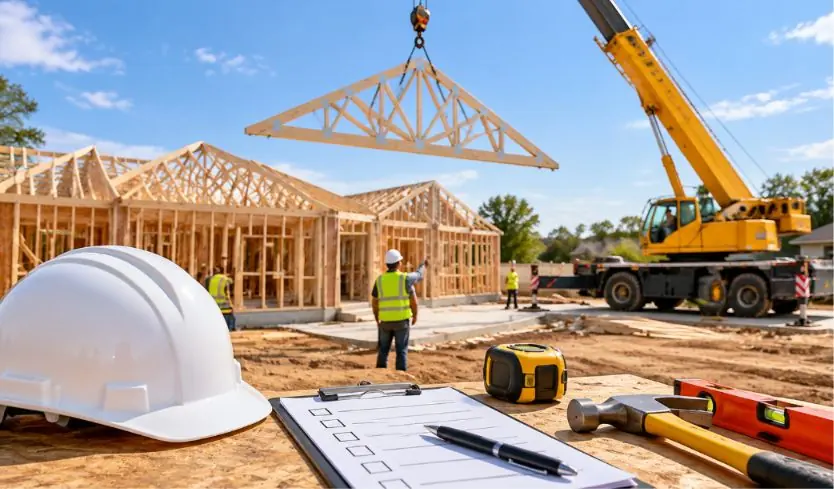
The walls are the first thing to check, because trusses can only go as fast as the walls can take them. Exterior walls should be plumb, straight and braced, with top plates fastened and truss layout marked on the plates at the spacing on the truss drawings.
Bearing walls and girder truss locations should be ready too, including any posts or headers under girders. Landing trusses on walls that are still moving slows every pick, makes the bracing harder and can throw the whole roof out of line before the second truss is set.
2. The Setup Spot Must Be Firm, Drained, Graded and Clear
The crane needs a place to stand close to the house, with room for its outriggers. Under OSHA 1926.1402, the controlling entity, usually the general contractor, must provide ground that is firm, drained and graded enough to support the crane at its planned lift.
Clear vehicles, dumpsters and material piles from the setup area, and mark septic tanks, utilities, drains and fresh backfill nearby. Soft lawns, new driveways and backfilled trenches near the foundation are common trouble spots on residential sites, especially in spring when frost leaves the ground.
Agree on the spot with the crane company before the crane date, not when the truck pulls in. A closer workable setup can reduce the required radius and may allow a smaller crane or simpler lift plan.
3. The Trusses Must Be Delivered, Stored and Sorted

The trusses themselves need the most preparation, and most of it happens when the delivery truck arrives. These four checks keep the bundles safe, straight and in the right order, so the crew can rig each truss and send it up without hunting through the pile.
Delivered Within Reach of the Crane
Have the truss supplier unload the bundles where the crane can reach them from its setup spot, ideally between the crane and the house. Trusses dropped on the far side of the lot or behind a stockpile add moves, rigging time and risk to every single pick.
Stored on Blocking, Off the Ground
Store trusses on blocking so they stay off wet soil and do not bend. BCSI guidance warns, “Do not store unbraced bundles upright.” Bundles stored flat on level blocking stay straight, while trusses left in mud or leaning against a wall can warp before they are set.
Sorted in Setting Order
Sort the trusses in the order they will be set, with girder trusses and any special trusses easy to reach first. A pile stacked in reverse order forces the crew to dig for each truss while the crane waits, which is exactly the delay a crane rental cannot afford.
Inspected for Damage
Look for broken webs, loose or damaged connector plates and cracked chords, especially on trusses moved by forklift. Report damaged trusses to the truss manufacturer and do not repair or set them until the appropriate repair instructions have been provided and approved. Set them aside before the crane date.
The takeaway is that trusses delivered close, stored flat on blocking, sorted in setting order and inspected for damage, then counted against the placement plan, let the crane pick steadily. Most truss-day delays trace back to a pile that was dropped, stacked or checked badly.
4. Temporary Bracing Must Be Cut and On Hand
Bracing is the item most often short on truss day. Have ground braces for the first truss and top chord lateral restraint for the rest cut and stacked before the crane arrives. Follow the project construction documents, truss submittal information and applicable BCSI guidance for temporary restraint and bracing.
Here is the trap. Unhooking each truss as soon as it lands is tempting, but BCSI says to hold each truss in position until top chord temporary lateral restraint is installed and the truss is fastened at its bearings. Released early, a row of trusses can fall like dominoes.
That rule makes bracing part of the crane schedule. If bracing runs short halfway through, the crane holds a truss in the air until more is cut. For trusses with clear spans of 60 feet or greater, BCSI calls for the owner to retain a Registered Design Professional for the temporary installation restraint/bracing and permanent individual truss member restraint/bracing.
5. The Crew Must Be Assigned and a Signal Person Added When Required
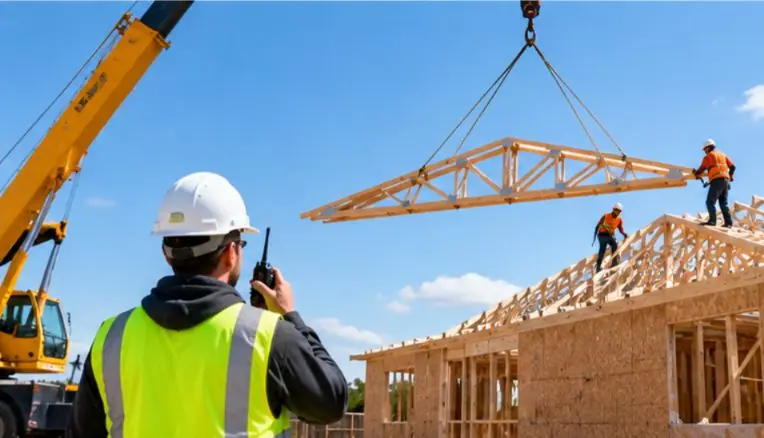
Decide who does what before the first pick. A small, well-assigned crew sets trusses faster than a large crowd on the walls. When the operator cannot see the landing point, OSHA 1926.1419 requires a signal person, and 1926.1428 says that person must be qualified before signaling:
- Signal person: Qualified, with hand or radio signals agreed in advance.
- Landing crew: Trained workers positioned to guide and fasten the trusses using the fall protection required for the work.
- Bracing crew: Installs lateral restraint before each truss is released.
Hold a short safety talk once the crane is set up, covering signals, the swing area and where people stand. Workers exposed to fall hazards must follow the applicable OSHA fall-protection requirements for the project. If your crew does not include a rigger, ask the crane company whether one can be added when you book, so rigging keeps pace with the set.
6. Overhead Lines and the Swing Area Must Be Checked
Overhead lines are the most serious hazard on many truss sets. Under OSHA 1926.1408, the work zone must be identified before crane work begins. For power lines up to 350 kV, the employer must determine whether any part of the crane, load line, rigging or load could come within 20 feet. If it could, one of OSHA’s required power-line safety options must be implemented before operations begin.
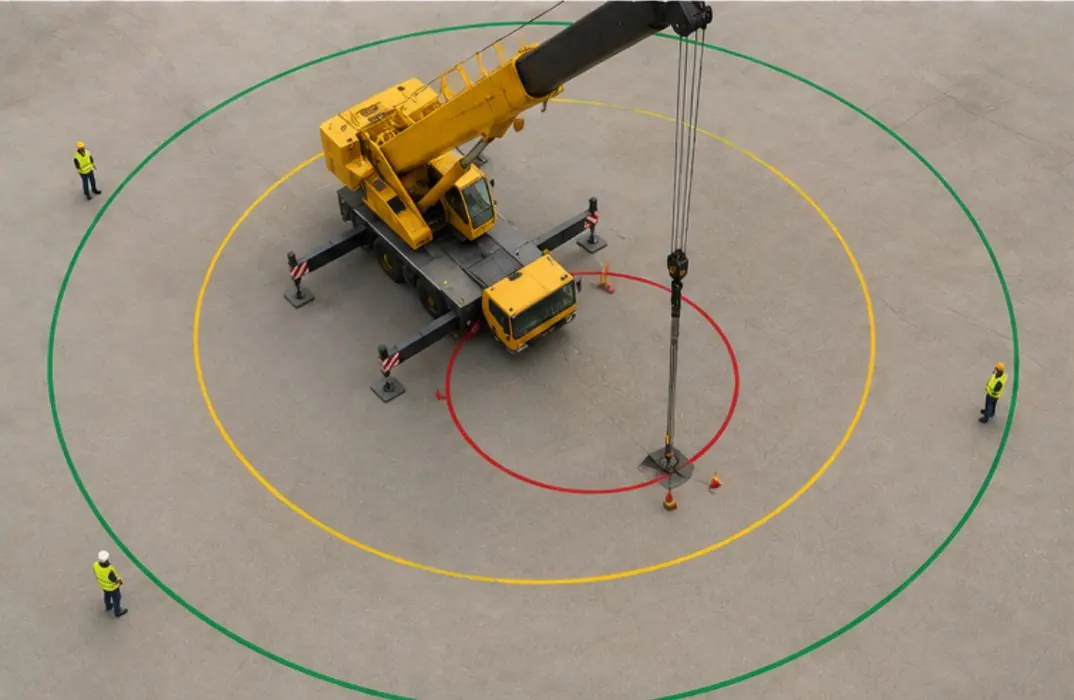
The crane’s rotating upper works can also strike or pinch workers, so OSHA 1926.1424 requires barriers or markings around the swing radius where people could be caught. Walk the lot for these hazards before booking, and mark anything that could interfere with the boom or a long truss:
- Service drops: Lines from the pole to the house often cross the lift path.
- Trees: Branches can block the boom or catch a swinging truss.
- Neighboring property: Outriggers may need space beyond the lot line.
- Street setups: A road setup may need a permit or traffic control.
If the required clearance cannot be maintained, coordinate early with the utility and crane provider on an OSHA-compliant power-line safety plan. A crane lift plan shows the boom path, outrigger spots and clearances for trusses and equipment before the crane is booked.
7. The Crane Company Must Have Your Lift Details
The crane company sizes the crane from the lift, so it needs real numbers well before the truss date. Send the heaviest truss weight, the longest span, the height to the top plate and the distance from the setup spot to the farthest wall where trusses will land.
Add the site details: address, access route, setup surface, overhead lines and photos of the lot. A guide to the information needed for a crane rental quote lists the full set, and reach often decides the crane more than weight on residential jobs.
8. HVAC Equipment Must Be Ready If It Shares the Visit

If the HVAC contractor plans to have attic air handlers, rooftop curbs, or platform equipment lifted during the truss installation, make sure everything is delivered and ready before the crane arrives. The crane company needs accurate equipment information to plan the lift, evaluate rigging requirements, and position each unit safely.
Before the scheduled lift, confirm these five details with your HVAC contractor and crane company:
- Equipment weight: Provide the exact weight of each unit, including any components that will be lifted with it.
- Dimensions: Share the length, width, and height so the crane company can evaluate clearance and rigging requirements.
- Rigging points: Identify the manufacturer’s approved lifting points and any special handling instructions.
- Final placement: Mark where each air handler, curb, or platform needs to be positioned.
- Delivery readiness: Have all equipment on site, uncrated when appropriate, and accessible for the planned lift.
Do not assume HVAC equipment can be placed on newly installed roof trusses immediately. The trusses must be adequately restrained and braced before construction loads are placed on them, and the equipment’s weight and placement must be accounted for in the truss design. Confirm approval with the truss designer and responsible project professionals before scheduling the lift. This guide to crane types for HVAC installations explains which crane options may be suitable for different equipment and jobsite conditions.
Your Day-Before Readiness Checklist
Use this checklist the day before the crane arrives. Walk the site with your framing lead and, if equipment is going up, the HVAC contractor, and confirm every line. Anything not ready is a reason to fix it tonight or move the crane date before dispatch:
| Item | Ready when | Owned by |
|---|---|---|
| Walls | Plumb, braced, plates fastened, layout marked | General contractor and framer |
| Setup spot | Firm, drained, graded, clear, hazards below marked | General contractor |
| Trusses | Within reach, on blocking, sorted, checked, inspected | General contractor and framer |
| Bracing | Cut, stacked and matched to the project bracing requirements | Framer |
| Crew and signals | Roles set, qualified signal person assigned when required | General contractor |
| Overhead lines | Work zone assessed and applicable OSHA clearance/protection plan confirmed | General contractor with the crane company |
| Lift details | Weights, reach and site photos sent | General contractor |
| HVAC equipment | Weights sent, loads approved by the truss designer | HVAC contractor with the GC |
Moving a crane date by a day usually costs far less than paying for crane time while the crew finishes bracing or hunts for a missing girder truss. With every line checked, most residential truss sets fit inside a half-day or full-day rental.
Why Choose MacDonald Crane for Truss Sets and HVAC Lifts?
At MacDonald Crane, we have provided operated crane rentals to general and HVAC contractors from South Easton since 2009. Every rental includes our operator, and we can add a rigger when you book. We plan tight lots with 3D lift planning before the crane date.
Trusses, lumber and HVAC equipment can be delivered to our Easton yard and stored until the lift, then hauled to your site with the crane. Our construction crane rentals and HVAC crane rentals can share one visit, so your framing crew and mechanical sub use the same crane day.
We run a Manitex 30-ton boom truck and a Manitex 50-ton crane with a 128-foot main boom, with a four-hour minimum rental, across Massachusetts, Rhode Island and New Hampshire. Call us at (508) 238-1055 to plan your truss set and equipment lifts.
Frequently Asked Questions
How long does it take a crane to set roof trusses?
It depends on the number of trusses, the house size, reach and how ready the site is. A prepared residential set often fits inside a half-day or full-day rental. Missing bracing, unready walls or a poor setup spot are the usual reasons it runs longer.
Who is responsible for the ground under the crane?
Under OSHA 1926.1402, the controlling entity, usually the general contractor, must provide ground that is firm, drained and graded enough to support the crane, and share any known hazards below. A competent person must inspect ground conditions as part of the crane’s each-shift inspection.
Who provides the temporary truss bracing?
Usually the framing contractor, under the general contractor. Follow the project construction documents, truss submittal information and applicable BCSI guidance for temporary restraint and bracing. Bracing should be cut and stacked before the crane arrives, because each truss must be restrained before the crane releases it.
Do I need a signal person to set trusses?
Often, yes. OSHA requires a signal person when the operator cannot see the landing point, which is common when trusses go over the far wall. The signal person must be qualified before giving signals. Agree on hand or radio signals before the first pick.
Can the crane set HVAC equipment the same day as the trusses?
Often, if it is planned ahead. Equipment should only be placed after the trusses are adequately restrained and braced, and its weight and location must be accounted for in the truss design. Give the GC and the crane company unit weights, rigging points and locations before the crane date.


 Get a Lift Quote