

In this article
- What Are the Standard Crane Hand Signals?
- What Are the Most Common Standard Crane Hand Signals?
- Who Can Give Standard Crane Hand Signals?
- How Is a Signal Person Different From a Spotter or Flagger?
- When Should Crews Use Radio or Voice Signals Instead?
- How Can Contractors Prepare for a Safe Crane Lift?
- Why Choose MacDonald Crane for Crane Rental in South Easton, MA?
- Frequently Asked Questions
A crane operator lifting an HVAC unit onto a commercial rooftop or placing structural steel on a construction project depends on clear communication with the crew on the ground. When the operator does not have a full view of the load travel or placement area, OSHA requires a signal person. One unclear gesture or conflicting command can send a heavy load in the wrong direction, putting workers, equipment, and the project at risk.
Standard crane hand signals, and who can give them, are governed by OSHA’s construction crane requirements. Under 29 CFR 1926.1419 and 1926.1428, OSHA’s Standard Method must be used when hand signals are used unless it is infeasible or does not cover the operation, and employers must ensure that signal persons are qualified before they direct crane movements. Only one person normally gives movement signals at a time, but anyone who recognizes a safety problem must alert the operator or signal person with a stop or emergency stop signal, which the operator must obey.
For HVAC contractors, general contractors, and construction supervisors, understanding these rules helps establish a reliable communication plan before a lift begins. Here’s how the standard signals work, who is qualified to use them, and what crews should do when visibility or site conditions make hand signals unreliable.
What Are the Standard Crane Hand Signals?
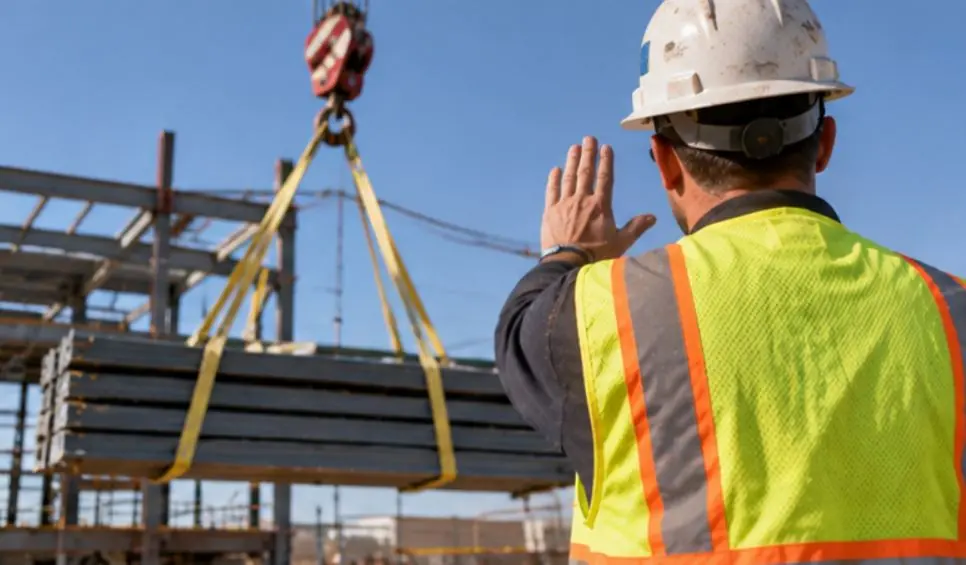
Standard crane hand signals are specific arm and hand movements used to communicate instructions to a crane operator. OSHA provides the standard hand signal method in Appendix A to Subpart CC of its construction regulations. The signals cover common crane functions, including hoisting, lowering, swinging, boom movement, and stopping.
The purpose is consistency. A signal person should not invent gestures or assume that a crane operator will understand a crew’s informal shorthand. When standard hand signals are used, the operator and signal person can communicate using an established set of movements. If standard signals are infeasible or do not cover a particular operation, nonstandard signals may be used only after the signal person, operator, and lift director, where applicable, agree on them before the operation.
Contractors can review the official OSHA Standard Hand Signals chart during pre-lift planning and training. OSHA requires the applicable hand-signal chart to be posted on the equipment or conspicuously posted near the hoisting operation.
What Are the Most Common Standard Crane Hand Signals?
The signals used depend on the crane and the movement required. The following table summarizes several common signals from OSHA’s standard method. Crews should consult the official illustrations for the precise motion, particularly for signals involving combined boom and load movements.
| Crane signal | Standard gesture | What it tells the operator |
|---|---|---|
| Hoist | Point the index finger upward and make small circles with the hand | Raise the load |
| Lower | Point the index finger downward and make small circles | Lower the load |
| Raise boom | Extend the arm horizontally with the thumb pointing up | Raise the boom |
| Lower boom | Extend the arm horizontally with the thumb pointing down | Lower the boom |
| Swing | Extend the arm horizontally and point in the direction of swing | Rotate the boom in the indicated direction |
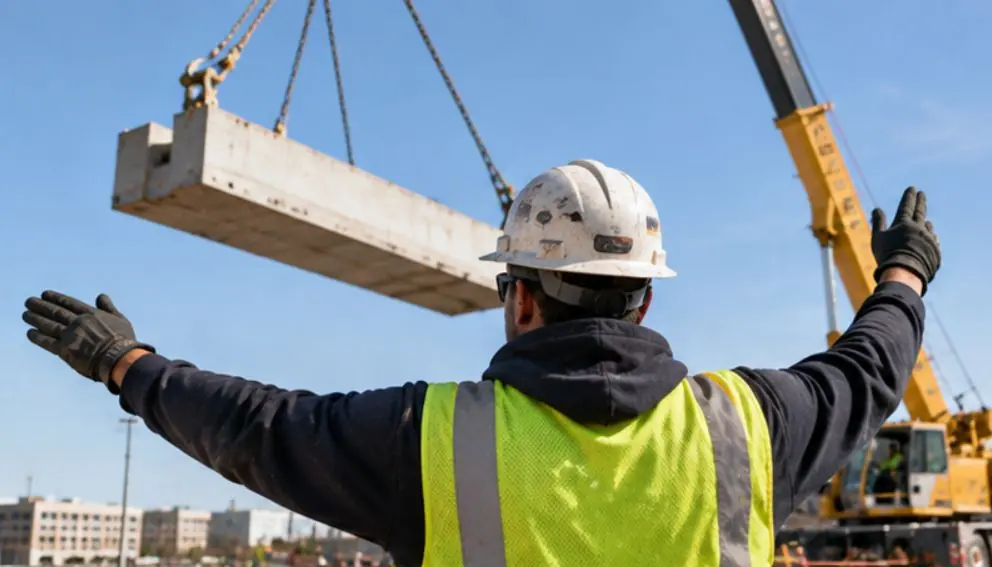
| Stop | Extend one arm horizontally, palm down, and swing it back and forth | Stop crane movement |
| Emergency stop | Extend both arms horizontally, palms down, and swing them back and forth | Stop immediately |
| Dog everything | Hold both hands together at waist level | Stop all crane functions and hold |
| Move slowly | Place one hand in front of the hand giving the action signal | Perform the indicated movement slowly |
Some cranes also require signals for telescoping the boom, using the main or auxiliary hoist, trolley travel, or crawler-crane travel. These are not interchangeable with general movement signals. For example, raising the boom and lowering the load is a different instruction from raising the load, so the signal person must give the correct standard gesture for the intended action.
Who Can Give Standard Crane Hand Signals?
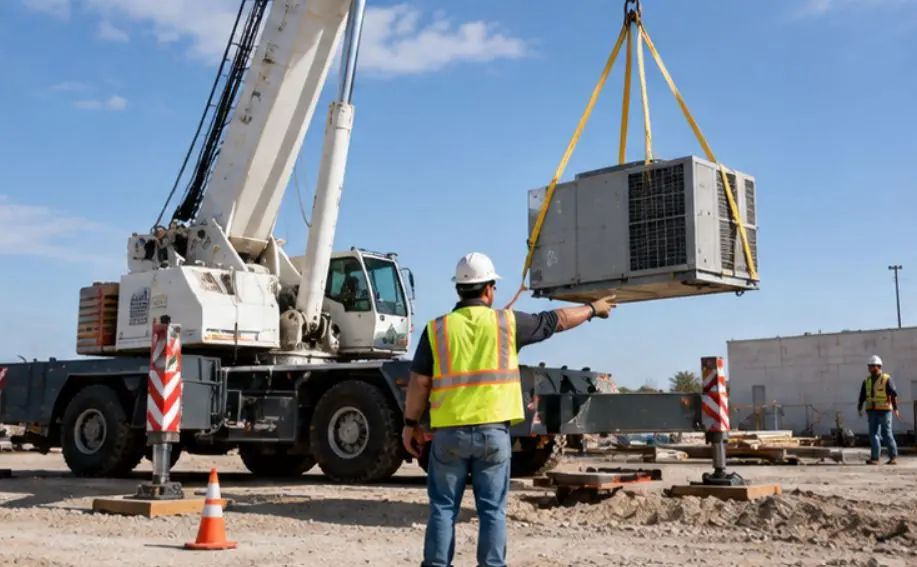
OSHA requires the employer to ensure that a signal person is qualified before that person gives crane signals. Under 29 CFR 1926.1428, qualification can be established through a third-party qualified evaluator or an employer’s qualified evaluator. The required documentation must be available at the worksite and identify the types of signaling for which the person is qualified.
A qualified signal person must demonstrate that they:
- Understand the signals used for the operation.
- Can apply those signals competently.
- Understand basic crane operation and equipment limitations.
- Understand relevant OSHA signaling requirements.
- Pass both a written or oral assessment and a practical test.
Being a foreman, experienced laborer, or worker with a clear view of the load does not automatically make someone qualified to direct crane movements. Employers must verify the person’s qualification and maintain the required documentation. If a signal person’s actions show that they no longer meet the qualification requirements, the employer must ensure retraining and reassessment before allowing them to continue in that role.
For contractors arranging crane rental services in South Easton, MA, signal-person responsibilities should be established during planning, not decided once the crane is ready to lift. The employer and site leadership should confirm who will direct the operator, what signaling method will be used, and how the crew will respond if communication is lost.
How Is a Signal Person Different From a Spotter or Flagger?
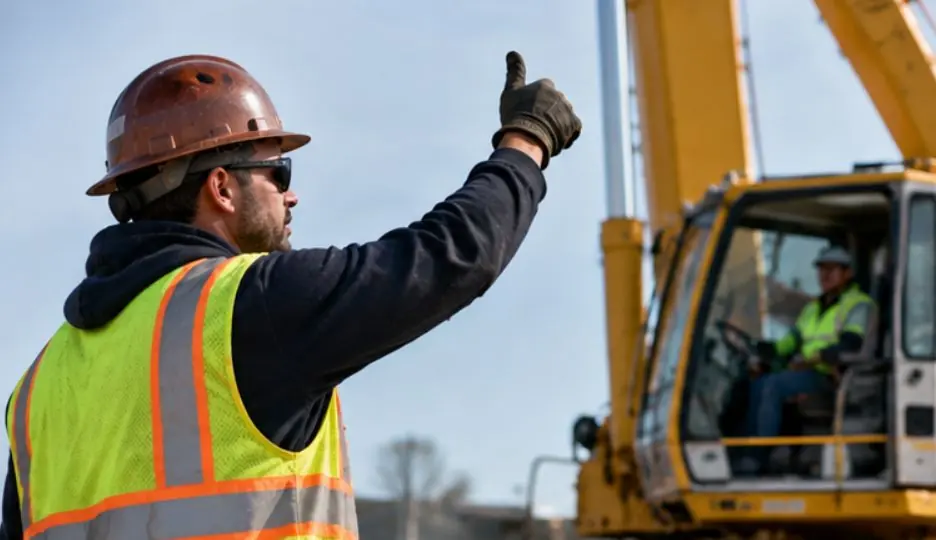
Construction crews may use the terms signal person, spotter, and flagger interchangeably, but the roles are not automatically equivalent. A signal person directs crane movements using the agreed signaling method and must meet OSHA’s qualification requirements. A spotter may watch for clearance problems or hazards, while a flagger typically manages pedestrian or vehicle traffic.
| Role | Main responsibility | Can direct crane movements? |
|---|---|---|
| Qualified signal person | Communicates crane movement instructions | Yes, within the agreed signaling arrangement |
| Spotter | Watches a specific hazard, clearance, or blind area | Not automatically; must be qualified and assigned as the signal person to direct the crane |
| Flagger | Controls traffic and helps keep people clear of work areas | Not automatically; the role alone does not establish signal-person qualification |
| Any worker who sees danger | Alerts the operator or signal person to an unsafe condition | Must alert them with a stop or emergency stop signal |
A spotter who notices an HVAC unit drifting toward a parapet should immediately alert the signal person or give the applicable stop signal if necessary. The signal person then communicates the movement instruction through the agreed method. The important distinction is that ordinary observation duties do not replace the qualification required to direct crane movements. For power-line clearance, OSHA’s defined dedicated spotter role has additional requirements and must meet the signal-person qualification standard.
OSHA generally allows only one person to give signals to a crane at a time, with specific exceptions in the standard. This prevents the operator from receiving conflicting directions. If the signal person changes, the handoff must be clear so the operator knows who is directing the next movement.
When Should Crews Use Radio or Voice Signals Instead?
Hand signals work only when the operator can see and interpret them clearly. If a building, rooftop edge, mechanical penthouse, or suspended load blocks the operator’s view, the crew may need voice, radio, or another suitable signaling method. OSHA requires the signaling method and means of transmission to be appropriate for site conditions.
Radio or voice signaling is often useful when:
- The load travels behind a building or other obstruction.
- The operator cannot see the landing area.
- The crane is working at a long reach.
- Poor lighting, weather, or distance makes gestures difficult to recognize.
- Multiple hazards require continuous coordination between the operator and crew.
Before a voice-signaled lift, the operator and signal person must establish the required communication protocol. OSHA’s voice-signal sequence is function and direction, then distance and/or speed when needed, followed by the function and stop command. For radio or other electronic signals, the equipment must be tested on site, transmissions generally use a dedicated channel, and the operator must receive them through a hands-free system.
If communication is interrupted, the operator must safely stop operations requiring signals until communication is reestablished and a proper signal is given and understood. The same principle applies to hand signals: when the operator cannot reliably see or understand the signal person, the lift should not continue on a guess.
How Can Contractors Prepare for a Safe Crane Lift?
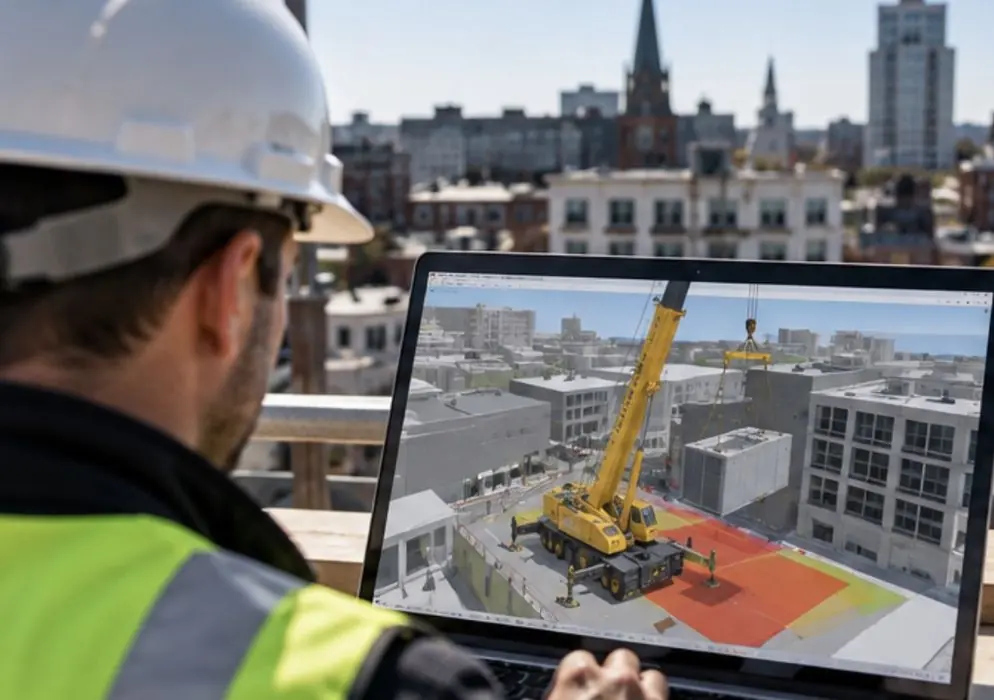
A safe lift starts well before the hook leaves the ground. HVAC contractors and general contractors should coordinate with the crane provider and site team to confirm the load, landing location, access restrictions, and communication plan. The signal person must be able to judge clearances and understand how crane movement affects the load.
Before the lift, make sure the team has addressed these points:
- Designate the signal person: Identify the qualified individual and verify the required documentation.
- Agree on signals: Use OSHA’s standard hand signals whenever feasible, or establish an approved alternative before the operation.
- Review the lift path: Identify obstructions, overhead hazards, blind areas, and people who must remain clear.
- Confirm the stop procedure: Ensure everyone knows how to call for a stop or emergency stop.
- Test communication: Check radios and confirm that the operator and signal person can communicate reliably.
- Coordinate the crew: Explain who directs the crane and how spotters, riggers, and other workers will communicate hazards.
These steps are particularly important for rooftop HVAC installations, where a heavy unit may need to pass over parapets, roof openings, or other equipment before reaching its final position. A well-planned crane-assisted HVAC installation accounts for both the lifting equipment and the communication needed to place the unit accurately.
Why Choose MacDonald Crane for Crane Rental in South Easton, MA?
For HVAC contractors and general contractors, coordinating a crane lift means planning the equipment, access, load path, and communication before work begins. MacDonald Crane provides crane rental services in South Easton, Massachusetts, supporting construction projects that require equipment placement and material handling. Discussing site conditions and lift requirements in advance helps contractors prepare for the work and coordinate with their crews.
Whether you are scheduling a rooftop HVAC unit placement or moving heavy materials on a commercial jobsite, MacDonald Crane’s crane rental services can help you plan the equipment needs for your project. Before the lift, make sure your team has identified the qualified signal person, agreed on the signaling method, and reviewed the procedure for stopping the operation if a hazard appears. To discuss your upcoming project, call (508) 238-1055 or request an estimate from MacDonald Crane.
Frequently Asked Questions
Can any worker give standard crane hand signals?
No. Crane movement signals must be given by a qualified signal person who meets OSHA’s qualification requirements. However, anyone who notices a safety problem must alert the operator or signal person with a stop or emergency stop signal, which the operator must obey.
How many people can signal a crane at one time?
Generally, only one person may give movement signals to a crane at a time, subject to specific exceptions in OSHA’s standard. This helps prevent conflicting instructions and ensures the operator knows whose directions to follow.
What should the operator do if a hand signal is unclear?
The operator should stop the operation safely rather than guess what the signal means. Crane movements should resume only when communication is restored and the signal is clearly given and understood.
Are standard crane hand signals the same for every crane?
OSHA’s standard method covers many common crane movements, but the applicable signals depend on the equipment and operation. Crews should review OSHA’s official hand signal chart and agree on any permitted alternative signals before the lift begins.
Can a spotter direct the crane operator?
A spotter cannot direct crane movements solely because they are watching the load or checking clearances. To serve as the signal person, the individual must meet OSHA’s qualification requirements and be assigned that responsibility. Anyone who sees danger must still alert the operator or signal person with a stop or emergency stop signal.
 Get a Lift Quote